
Cyber Security News and Advice
Making sense of Cyber Security for business owners

The AI risk hiding inside your suppliers
Do you know what risks are lurking in your supply chain as thousands of firms adopt AI using cheaper Chinese models?

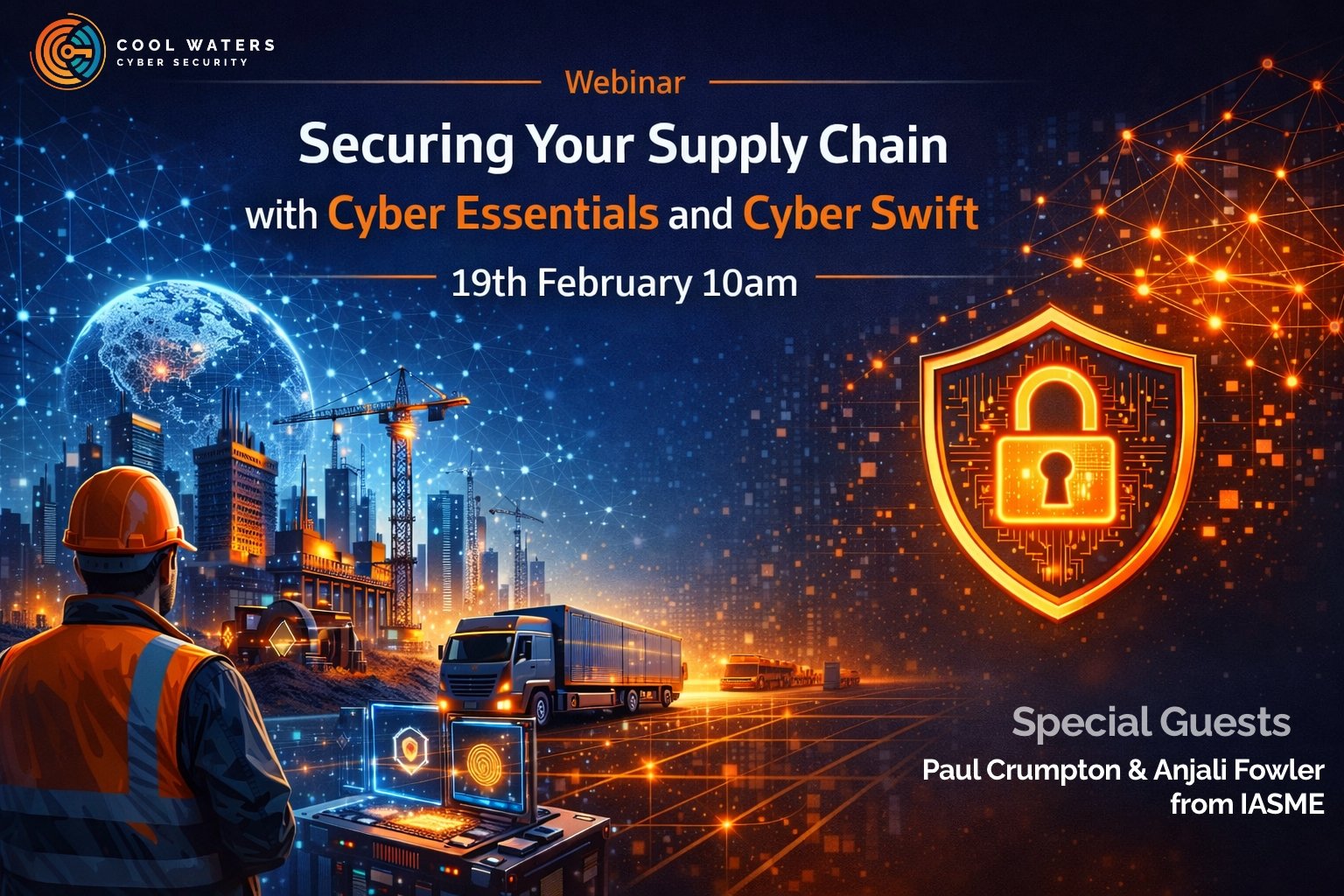
Webinar: Secure your supply chain with Cyber Essentials and Cyber Swift
If you’re tired of supply chain security being a vague worry, a painful spreadsheet exercise, or a contractual panic at tender time — this webinar will give you a practical, modern way to take control.

Supply Chain Cyber Risk: The Threat You Can't Afford to Ignore
Your organisation might have robust cyber security controls in place. You may have invested in firewalls, endpoint protection, and staff training. But here's the uncomfortable truth: your security is only as strong as your weakest supplier.
When Cyber Security Becomes a (Construction) Project Problem
Why managed supply chain cyber security matters on defence and public-sector construction projects
For a long time, cyber security in construction lived somewhere off to the side. It was an IT concern, handled centrally, largely invisible to project delivery teams.
That has changed.
On defence and public-sector projects, cyber security now turns up early and forcefully — in tender conditions, framework rules, and mobilisation requirements. Increasingly, it is not optional, and it is not abstract.

NCSC 2025 Review: UK Cyber Threats, Supply Chains, and the rise of AI
The NCSC Annual Review 2025 delivers a clear warning: UK organisations must take cyber resilience seriously, especially across their supply chains. This article breaks down the key messages for business leaders and explains how Cool Waters Cyber and our Cyber Swift Supply Chain Portal help companies identify, monitor and manage cyber risks before they disrupt operations.

The Hidden Cyber Risks in Your Supply Chain
When most organisations think about cyber security, they focus on protecting their own networks, staff, and data. Yet time and again, breaches are happening through the back door — via trusted suppliers.
A growing number of high-profile incidents have shown how a cyber attack against one supplier can ripple out to hundreds of customers. It’s not just large enterprises that face this risk; small and medium-sized businesses are equally exposed when the systems or services they rely on are disrupted.

Cyber Safety in Construction
To integrate cyber safety into an organisation’s culture, businesses must go beyond compliance checkboxes and isolated IT training. Instead, we advocate for a structured, behaviour-driven approach that mirrors the success of physical and mental health safety campaigns. This article provides actionable steps construction firms can take.
Beyond the Firewall: Why Supply-Chain Cyber Security Is Really About Keeping the Lights On
When people first began talking seriously about “third-party cyber risk” a decade ago, the conversation centred almost entirely on privacy and data protection. If a supplier mislaid a laptop or sent the wrong spreadsheet, the danger was embarrassment, a possible fine and perhaps a headline about leaked personal data. Important, yes—but rarely business-critical.

Benefits of Cyber Essentials in 2025
Imagine if there was a business insurance policy that reduced your chances of making a claim by 92%. You'd snap it up without hesitation, wouldn't you? Well, that protection exists – and it's called Cyber Essentials. Yet astonishingly, only 12% of UK businesses are aware of this government-backed scheme that could be the difference between staying in business and becoming another cyber crime statistic.

Cyber Security in 2025: What UK Business Leaders Need to Know
Running a business has never been more challenging. Between managing cash flow, keeping customers happy, and staying ahead of the competition, cyber security often feels like another overwhelming task on an already packed agenda. But here's the reality: ignoring cyber threats in today's digital world is like leaving your office doors unlocked overnight – eventually, someone will walk in.
The government's latest Cyber Security Breaches Survey 2025 reveals some eye-opening truths about the state of UK businesses. More importantly, it shows clear, practical steps you can take to protect what you've worked so hard to build.

A Proven Path to Implementing the UK Cyber Governance Code with IASME Cyber Assurance
The recent statistics are eye-opening: 70% of medium businesses and 75% of large businesses in the UK have experienced a cyber breach in the past year. With digital risks continuing to mount, the UK government has introduced the Cyber Governance Code of Practice to guide boards and directors in their oversight of cyber risk.
But for many organisations, a burning question remains: "How do we actually implement this in practice?"
At Cool Waters Cyber, we've answered this question with our comprehensive guide: "Implementing the UK Cyber Governance Code with IASME Cyber Assurance: A Practical Roadmap." Today, we're sharing key insights from this report to help your organisation navigate the path to stronger cyber governance and providing a free download of the full report.

Strengthening Leadership on Cyber Risk: A Practical Guide to the New UK Cyber Governance Code of Practice
The UK Government has launched a new Cyber Governance Code of Practice aimed squarely at boards and directors of medium to large businesses and charities. Its message is clear: cyber security is no longer just an IT issue. It is a core business risk that must be actively governed at the highest level.

Beyond the Annual Audit: Why PCI Compliance Should Be an Ongoing Service, Not a Stressful Sprint
For many organisations, PCI DSS is still treated as a once-a-year hurdle—something to rush through, report on, and then forget until next time. But that approach creates gaps, introduces risk, and adds pressure that no business needs.

Quantum Computing: What It Means for Your PCI Compliance
The idea of quantum computing might sound like science fiction—but it’s becoming science fact faster than most businesses realise. While we’re still years away from fully operational quantum computers, developments are accelerating—and they could have serious implications for the way we protect sensitive data.

Passkeys: A deep dive for IT Managers
Passkeys have gained prominence because they directly address the growing weaknesses of password-based security. Cybersecurity risks related to passwords are well-documented: the majority of cyber breaches involve lost, stolen, or weak credentials . Attackers commonly obtain passwords via phishing scams, database breaches, or by exploiting password reuse. Traditional passwords are simply not adequate protection on today’s internet

Not all ISO 27001 certificates are the same – how to avoid expensive mistakes
When your customers request ISO 27001 certification, it's because they need credible assurance that your information security is robustly managed. However, many businesses fall into the trap of obtaining an ISO 27001 certificate that isn't accredited by a recognised body like the United Kingdom Accreditation Service (UKAS)
Cyber Safety Briefing: Say Goodbye to Passwords, Hello to Passkeys!
Passwords are out, and passkeys are in! But what exactly are passkeys, and why should you care?
The Next Big Shift in Construction Safety: Are You Ready for Cyber Safety?
For decades, the construction industry has worked tirelessly to improve health and safety culture. What was once a regulatory headache has transformed into a core business value, saving lives and improving project outcomes.
Now, a new safety frontier is emerging—one that construction firms can no longer ignore: Cyber Safety.

ISO 27001: Why It’s Not Just for Large Corporations
Many small and medium-sized businesses (SMBs) believe that ISO 27001 certification is something only large corporations need. After all, isn’t cybersecurity just an issue for massive enterprises with thousands of employees and deep pockets?
The truth is, cyber threats don’t discriminate based on company size. In fact, the latest NCSC Annual Review 2024confirms that smaller businesses are prime targets for cybercriminals, particularly those handling sensitive data or sitting in the supply chain.